
Imagine you’re on a Tuesday afternoon, dashboards open, arbitrage screen flashing across two DEXs, and you catch a fleeting price discrepancy on Arbitrum. The trade looks clean, but the dApp’s approval flow asks you to sign a complex call you don’t fully recognise. Do you click approve because speed matters, or do you stop and inspect? That moment — ubiquitous for active DeFi users — is the concrete problem Rabby’s browser extension and desktop clients aim to solve.
This article walks through a realistic case: a U.S.-based DeFi trader who wants a secure, multi-chain wallet that preserves speed while avoiding dangerous “blind signing.” Using Rabby’s feature set as the evidence base, I explain how transaction simulation, pre-sign risk scanning, hardware wallet support, and network automation work together, what they do not do, and how to judge whether Rabby (or any wallet) meaningfully reduces your operational risk.
How Rabby attacks the blind-signing problem
At the mechanism level, Rabby’s core defensive move is pre-execution simulation. Before you sign, the wallet replays the transaction against a local or remote node and presents the estimated token balance changes and explicit fee breakdown. That matters because raw transaction payloads are often opaque: a single high-level “swap” call can include nested token transfers, approvals, or recollateralization steps. Simulation translates bytecode into human-actionable numbers: “You will lose X token, gain Y token, and pay Z in gas.”
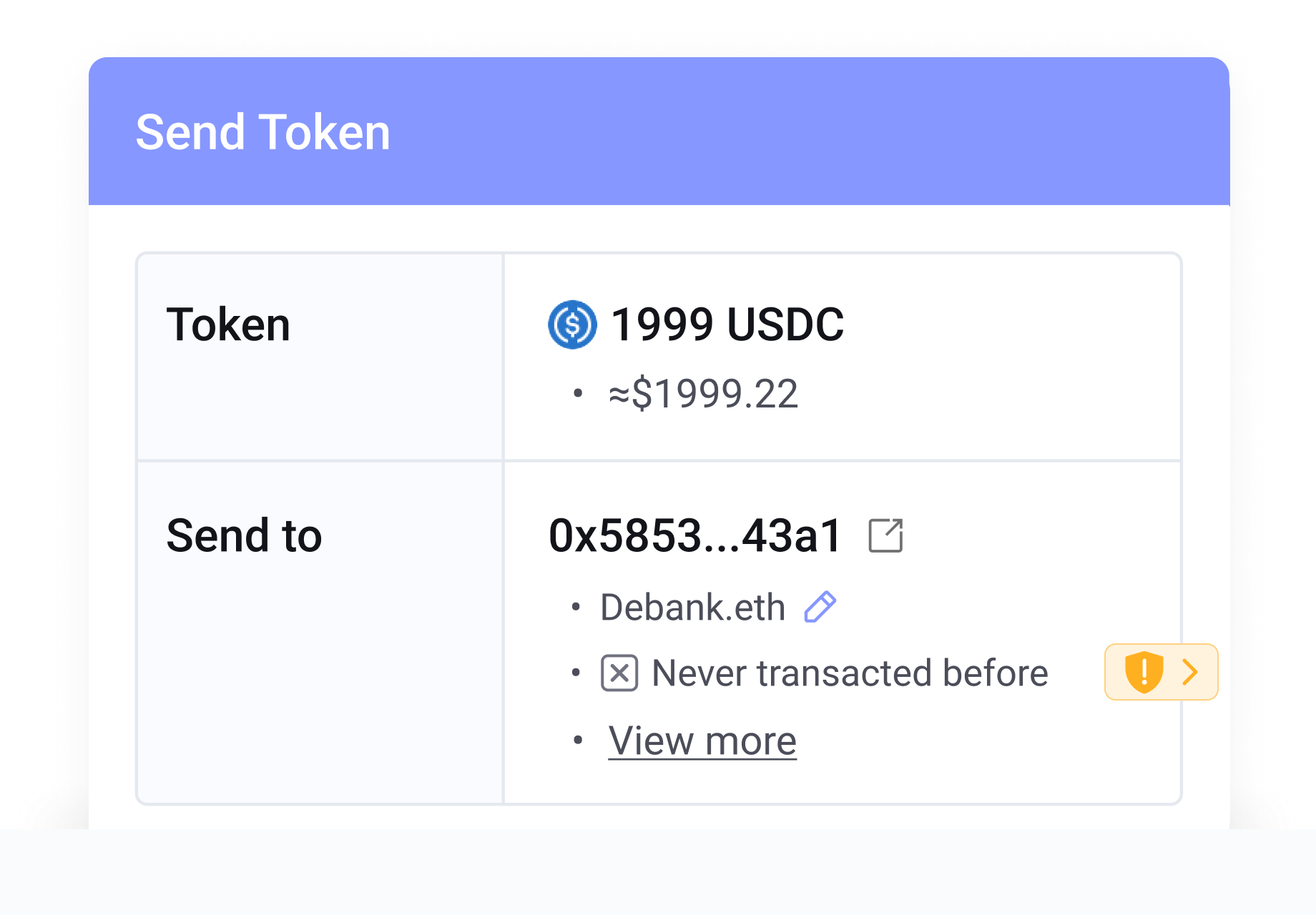
Layered on top of simulation is a security engine that flags contextual risks: known hacked contracts, suspicious approval requests (for example, unlimited allowance), or recipient addresses that have never appeared on-chain. This dual approach — simulation plus risk scoring — changes the decision from “Do I trust this contract?” to “Does the numeric outcome and risk profile match my intent?” For many chain-hopping DeFi users, that reframing is the difference between an avoidable loss and an ordinary trade cost.
Case walkthrough: an Arbitrum sandwich
Consider a specific scenario: you plan a leveraged swap on an Arbitrum DEX, funded from a wallet that also holds assets on Ethereum mainnet and BNB Chain. You have a Ledger attached for custody and want to avoid manual network switching while monitoring active approvals.
With Rabby’s browser extension (available on Chromium-based browsers) or its desktop app, three mechanics deploy in concert: automatic network switching detects the dApp and flips Rabby to Arbitrum; simulation shows the exact token inflows, outflows, and gas cost in ETH-equivalent; and the approval revocation tool allows a quick audit of any preexisting unlimited allowances to the DEX’s router. If anything looks off — a non-zero transfer to an unfamiliar address or a suspicious contract signature — the pre-transaction scanner surfaces an alert before you physically confirm on your Ledger.
That flow preserves speed (automatic switching and aggregated portfolio context) while maintaining tactile safety (hardware wallet signing and simulation outputs). But the setup is not magically infallible: simulation depends on accurate node state and oracle responses, and risk lists are as good as their data feeds and heuristics. In short, Rabby reduces information asymmetry but does not remove all classes of risk.
Trade-offs and limitations you must weigh
No wallet is a complete safety net. Here are the most consequential trade-offs and boundary conditions to keep in mind when adopting Rabby as your DeFi operations hub.
1) Simulation is powerful but not omniscient. Simulating a transaction gives a best-effort estimate of token changes and gas, but it relies on current on-chain state and the node oracle used. Reorgs, mempool mutations, or complex cross-contract callbacks can produce edge cases where simulated and actual outcomes diverge. Treat simulation as high-quality information, not a formal guarantee.
2) Security engines flag known or suspicious vectors, but they don’t abolish novel exploits. Rabby’s scanner effectively surfaces previously exploited contracts and common suspicious patterns (e.g., approvals that would allow total balance drain). However, zero-day logic bugs in a new contract, or cleverly constructed multi-step exploits, can still bypass heuristics. Human judgement remains essential.
3) No fiat on-ramp or native staking convenience. Rabby focuses on transaction safety, multi-chain support (90+ EVM chains), and institutional integrations, but it lacks an in-wallet fiat purchase flow and built-in staking primitives. If you want one-click fiat buys or integrated staking dashboards inside the wallet, you’ll need complementary services or custodial platforms.
4) Past incidents matter. Rabby’s ecosystem experienced a contract exploit in 2022 tied to Rabby Swap (about $190k). The team froze the contract, compensated users, and increased audits — a constructive response — but the incident is a useful reminder that open-source, audited code reduces but does not eliminate systemic risk.
Where Rabby stands in the multi-wallet ecosystem
Compared with commonly used alternatives like MetaMask, Trust Wallet, or Coinbase Wallet, Rabby differentiates explicitly on simulation and automatic network switching. For a power user who values transaction-level clarity and cross-chain convenience, those are practical advantages: fewer accidental network mismatches, clearer immediate outcomes, and a built-in revocation tool to reduce long-tail allowance exposure.
Institutional teams will notice the integrations with multi-sig and custody suites like Gnosis Safe, Fireblocks, and Amber. Combined with hardware wallet compatibility across Ledger, Trezor, Keystone and others, Rabby positions itself as a pragmatic middle-ground: stronger than a basic browser wallet but lighter and more flexible than full enterprise custody — useful for advanced traders, small funds, and DAO treasuries that want a hands-on, auditable setup.
Decision-useful heuristics for adopting Rabby
Here are three specific heuristics to decide whether to add Rabby to your toolkit:
– If you routinely interact with many EVM chains and dApps, Rabby’s automatic network switching and support for 90+ chains will reduce cognitive load and costly mistakes from manual network flips.
– If your operational risk model prizes explicit transaction outcomes over blind speed, the simulation + scanner combo is a material upgrade; use it particularly for approval and cross-contract flows where numeric clarity matters.
– If you require fiat on-ramps or integrated staking dashboards as core workflow components, you’ll still need external services, because Rabby intentionally focuses on security and multi-chain transaction tooling rather than native fiat or staking primitives.
What to watch next (conditional scenarios, not promises)
There are three plausible near-term signals that would change Rabby’s utility profile materially:
– Broader adoption by institutional custody providers would tilt Rabby from a power-user tool to an enterprise standard; evidence would include more audited connectors and formal compliance integrations.
– Improvements in simulation fidelity (for example, more robust mempool-aware simulation or cross-chain atomicity checks) would shrink the residual gap between simulated and real outcomes and further reduce blind-signing risk.
– Conversely, any new class of automated exploit that deliberately obfuscates simulated outcomes would expose a design limitation shared across simulation-first wallets; detection of such an exploit would require new defensive primitives beyond current heuristics.
How to test Rabby yourself (practical checklist)
Before making Rabby your default browser wallet, run a short acceptance test: install the Chromium extension, connect a hardware wallet, visit three different dApps (one on Ethereum, one on Arbitrum, one on BNB Chain), and verify automatic network switching. Create or import a small test account and submit token approvals to observe the approval revocation tool. Finally, perform a harmless swap with minimal funds and compare the simulation output with the actual transaction receipt.
If the simulation, balance deltas, and flagged risks align with your intent across these checks, Rabby is likely to reduce your operational risk in daily DeFi workstreams.
To download and explore the browser extension and other clients, a convenient starting point is the Rabby project page: rabby.
FAQ
Does Rabby prevent all smart contract exploits?
No. Rabby reduces the chance of user error and flags known risks, but it cannot guarantee safety against novel smart contract vulnerabilities or complex, previously unseen exploit techniques. Simulation and risk scanning are powerful risk mitigants, not absolute protections.
Can I use Rabby with my Ledger or Trezor device?
Yes. Rabby supports a wide range of hardware wallets (Ledger, Trezor, Keystone, CoolWallet, GridPlus, BitBox02), letting you keep private keys offline while still benefiting from Rabby’s simulation and risk checks.
Will Rabby show me exactly how much gas I’ll pay?
Rabby presents an estimated gas cost alongside token balance changes. Estimates are usually accurate under ordinary conditions but can shift due to network congestion or transaction replacement (e.g., gas bumping). Treat the gas figure as an informed estimate.
Is Rabby open-source and auditable?
Yes. Rabby is released under the MIT license, which enables independent audits and review. Open-source status increases transparency but does not replace rigorous operational security or ongoing audits.